Introduction
Most wall lights do one thing - they provide light. They do it efficiently, inoffensively and without contributing much else to the room they occupy.
Marble wall lights do something entirely different. They provide light, yes - but they also introduce material depth, natural texture and a quality of warmth that changes the character of a room. The fitting becomes part of the interior rather than a functional addition to it.
For anyone weighing up whether the investment in natural stone lighting is worthwhile, this guide examines what separates marble wall lights from conventional alternatives - and why, for a considered interior, the answer is rarely close.
What Standard Wall Lights Offer
Standard wall lights — those made from ceramic, glass, metal, fabric or resin - are designed primarily around function and accessibility. They are widely available, straightforward to install and produced in enormous variety.
Their limitation is consistency. Because they are manufactured from uniform materials, every unit within a range looks identical. A ceramic wall light carries no inherent character of its own, its appearance is determined entirely by the glaze applied to it, which can be replicated indefinitely and replaced easily.
This uniformity is fine for functional spaces. For interiors where material quality and individuality matter, it becomes a significant constraint.
What Marble Wall Lights Offer Instead
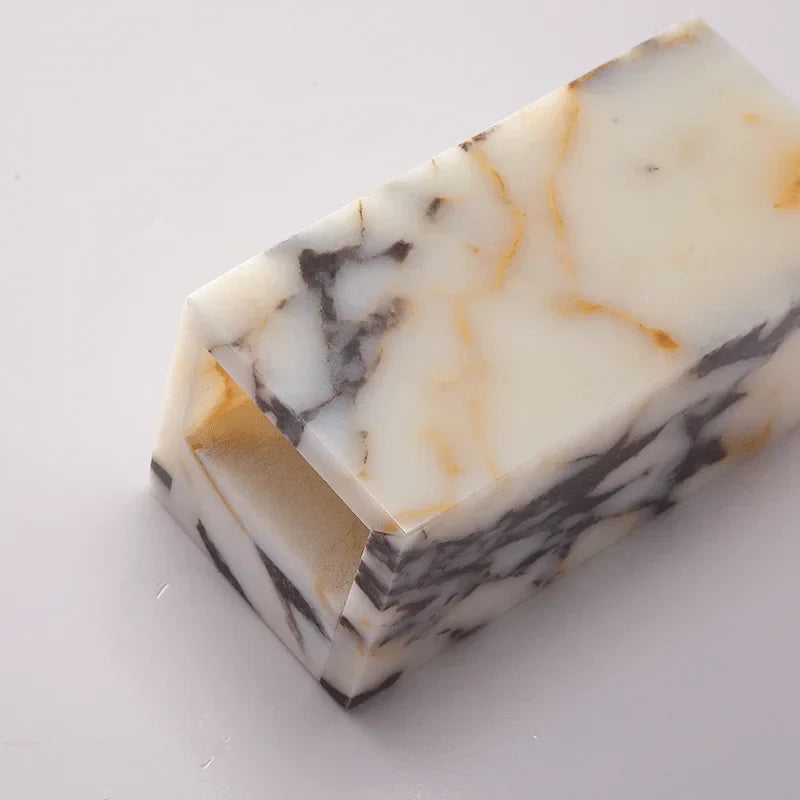
Natural stone is formed over millions of years under heat and pressure. The mineral deposits, veining patterns and colour variations that result from this process cannot be manufactured, replicated or predicted. Each piece of marble that leaves a quarry is genuinely unique.
When that stone becomes a wall light, it brings all of that character with it. The veining catches light differently depending on the time of day. The surface temperature changes subtly with the seasons. The weight and density of the material gives each fitting a presence that resin and ceramic simply cannot achieve.
This is the fundamental difference - a marble wall light is a natural object that has been given a purpose, rather than a manufactured product designed to fill a function.
Marble Ages Where Standard Lights Date
One of the most compelling arguments for natural stone lighting is longevity - not just physical durability, but aesthetic longevity.
Trends in interior design move in cycles. Fittings that feel contemporary today can feel dated within five to seven years as finishes, forms and styles shift. Natural materials sit outside this cycle. Marble has been used in interiors for thousands of years precisely because its visual quality is not dependent on current taste - it is inherently beautiful regardless of what is fashionable around it.
A marble wall light installed today will look as considered in fifteen years as it does now. The same cannot be said for most manufactured alternatives.
The Design Versatility of Natural Stone
A common misconception is that marble wall lights suit only classical or traditional interiors. The reality is that natural stone is one of the most versatile materials in contemporary design - it appears in minimalist Scandinavian interiors, in raw industrial spaces, in warm Mediterranean schemes and in ultra-modern architectural projects alike.
The Luna Marble Round Wall Light demonstrates this versatility clearly. Its circular organic form sits comfortably in modern interiors built around clean lines and neutral palettes, yet the natural stone finish gives it a warmth and humanity that purely geometric manufactured fittings lack. It works equally well in bedrooms, living rooms and hallways where the brief is understated refinement rather than statement design.

When Vertical Form Meets Natural Stone
The orientation of a wall light fundamentally changes how it interacts with a space. A vertical form draws the eye upward, emphasises ceiling height and creates a more architectural quality of illumination than a horizontal or compact fitting.
The Roma Marble Vertical Wall Light uses this principle to exceptional effect. Its elongated vertical profile casts light both upward and downward along its full length, washing the surrounding wall surface with a soft, continuous glow. In hallways, beside staircases and in living rooms where height is a feature, it creates a lighting effect that no standard fitting can replicate.

Completing the Scheme - Marble Pendant Lights
The most coherent interior lighting schemes carry a consistent material story across the full vertical plane of a room - from ceiling to wall. Pairing marble wall lights with a marble pendant creates a unified aesthetic where the natural stone reads as a deliberate design decision rather than a single accent piece.
The Siena Marble Column Pendant Light pairs naturally with the wall light range, its column form echoing the vertical language of the Roma Vertical and Siena wall lights. Over a dining table or in an entrance hall, it completes a marble lighting scheme with the same natural stone craftsmanship throughout.
Explore our marble pendant lights for the full range of ceiling lighting designed to complement our wall light collection.

The Verdict
Standard wall lights illuminate a room. Marble wall lights transform one.
For interiors where material quality, individuality and longevity matter - and where the details are as considered as the larger design decisions - natural stone lighting is not an extravagance. It is the most honest choice.
Explore the complete marble wall lights collection to find the right piece for your interior, or read our guide on how to style marble wall lights in every room for room-by-room installation advice.
For more on why natural stone lighting has become a defining feature of modern luxury interiors, read marble wall lights: the perfect balance of architecture and lighting.


